Check Winter Indoor Humidity and How to Choose a Humidifier
This page contains Coupang Partners affiliate links; the operator may earn a commission.
Key Takeaway
If your room is dry in winter, set a target humidity before turning the humidifier up. The KDCA recommends 40 to 50% indoors in winter.
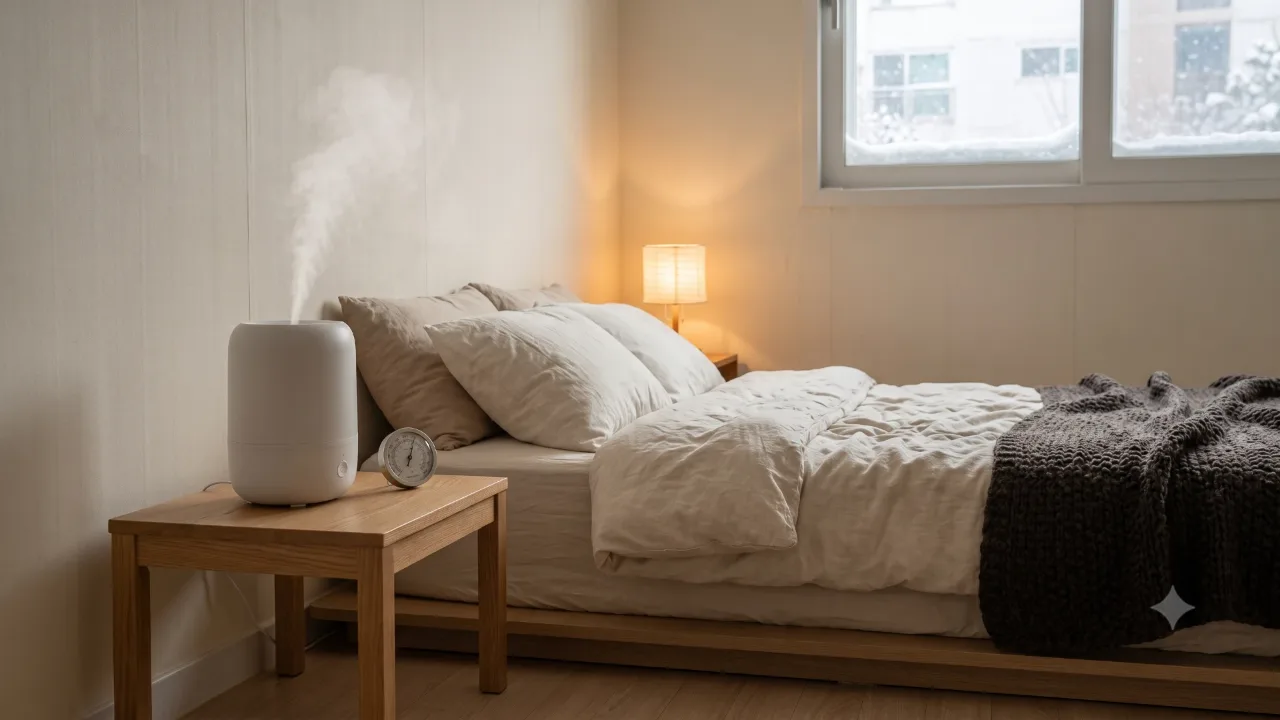
Check the humidifier's output (ml/h) against your room size, because too much output can push humidity too high and cause mold.
What indoor humidity is right in winter?
Each standard has a different target. The Korea Disease Control and Prevention Agency (KDCA) guidance covers ordinary homes in winter, while the Ministry of Employment and Labor's VDT work management guideline covers workplace work areas. This article follows the former for home use and treats the latter as a reference.
| Source | Applies to | Standard |
|---|---|---|
| KDCA | Indoors in winter | Humidity 40 to 50% |
| Ministry of Employment and Labor VDT work management guideline | Workplace work areas | Humidity 40 to 70%, temperature 18 to 24 degrees |
The KDCA gives two reasons to watch humidity separately in winter. There is less water vapor in the air, and heating dries a room out easily. It says that dry air dries out the mucous membranes of the nose and airways, the skin, and the eyes, and can lead to respiratory or allergic illnesses.
Can you raise humidity without a humidifier?
The KDCA also lists everyday ways to add humidity: hanging wet laundry or towels in the room, or leaving bowls of water out. Water-soaked charcoal, potted or hydroponic plants, moss decorations (topiary), and fish tanks are also on the list. But the guidance doesn't say how many percent these methods raise humidity. Put out a hygrometer and add or remove methods while watching whether it stays within 40 to 50%.
How do you set ventilation and room temperature?
The same KDCA guidance recommends an indoor winter temperature of 18 to 20 degrees C. That is a narrower range than the 18 to 24 degrees for work areas in the VDT guideline in the table above. For ventilation, open the windows for about 10 to 30 minutes at a time, three times a day, every 2 to 3 hours, and it explains that opening two windows facing each other lets the air change well. It recommends doing this between 10 a.m. and 7 p.m.
For homes with elderly people or children, it says body temperature can drop even when the room is at 22 to 24 degrees C. The KDCA recommends sticking a thermometer where you can see it in winter and checking it often.
Why look at output (ml/h) first?
The Korea Consumer Agency tested the output of 13 humidifiers. The test conditions were an air temperature of 20 +/- 1 degrees C, a water temperature of 20 +/- 1 degrees C, and a humidity of 30 +/- 3%. The results are as follows.
| Item | Test result |
|---|---|
| Number of products tested | 13 |
| Output | 182 to 606 ml/h (up to 3.3 times difference between products) |
| Coverage area | 12.9 to 42.9 square meters |
Even among humidifiers, output varies greatly from product to product, so check in the spec sheet for the coverage area and output that suit your room size.
More output is not simply better. The Consumer Agency explains that too much output makes mold likely to form, and too little won't reach a suitable humidity, so the room stays dry. The coverage area in the test is a figure converted by applying the one-hour output to the indoor floor area of a Seoul apartment. When you look at the coverage area printed on a product, check the output (ml/h) figure as well.
How much do noise and running costs differ?
Maximum noise ranged from 37 to 62 dB depending on the product, and heating-type products rose to 52 to 55 dB while the water first came to a boil. Running costs differed by more than 40 times at most, depending on the product. If the humidifier will go somewhere that needs to be quiet, like a bedroom, compare the noise listings, and if it will run for a long time, compare the running costs too.
The Consumer Agency gave the fact that a humidifier can stay on even while you sleep as the reason to compare noise. The difference that an average person notices as a change in loudness is 3 dB. Running costs were calculated on a one-year basis, adding up electricity and filter replacement costs, and the two highest products were cases that included the cost of replacing air-cleaning filters.
How do humidifying methods differ?
The products tested included 4 ultrasonic, 3 heating-type, 3 hybrid, and 3 evaporative models. The principle behind three of these methods is as follows.
| Method | Principle |
|---|---|
| Ultrasonic | Breaks water into fine particles by vibration and sprays it |
| Heating type | Boils water and releases it as steam |
| Hybrid | Uses two methods together |
In the safety check, all 13 products had no problems with electrical or structural safety. All products also met the standards for legally required markings such as KC certification and electromagnetic compatibility. Look for these two items on the product label when you buy.
What should you keep in mind when using and maintaining one?
- Water and humidifier: Don't put additives in the water, and fill it to the line on the tank. Clean a humidifier that has been in storage for a long time before running it.
- Placement: Put it on a flat floor and don't move it while it's running. Don't leave it on for long in a closed room with no ventilation.
- You and the room: Don't breathe in the sprayed moisture directly, and check that indoor humidity is within 40 to 50%.
Product information
Candidates compared
-
Zojirushi Steam Humidifier 3.1L EE-DCH35K
-
Zojirushi Steam Humidifier 4L EE-DVH35K
Check price and stock at the link. Product information is as of the date checked.
Frequently Asked Questions
Is higher humidity better?
No. The Korea Disease Control and Prevention Agency advises keeping winter indoor humidity at 40 to 50%. The Korea Consumer Agency explains that too much humidifier output can push indoor humidity too high and cause mold.
Can I add scents or additives to the humidifier water?
It's best not to. The guidance summarizing the Consumer Agency's test results urges people not to put additives in a humidifier.
Sources & Verification Date
- Health rules for preparing for winter cold waves (Korea Disease Control and Prevention Agency, National Health Information Portal) · Verified
- Quality comparison of 13 humidifiers! Differences in output and running costs (Korea Consumer Agency webzine) · Verified
- Work Management Guideline for Workers Handling Video Display Terminals (VDT) (Ministry of Employment and Labor Notice No. 2020-17, Korean Law Information Center) · Verified
All materials have been verified from official announcements and may have changed since verification.