Make Sure Your Storage Cabinet Won't Tip Over
This page contains Coupang Partners affiliate links; the operator may earn a commission.
Key Takeaway
If you have a chest of drawers or a bookshelf at home, first check whether it's secured to the wall.
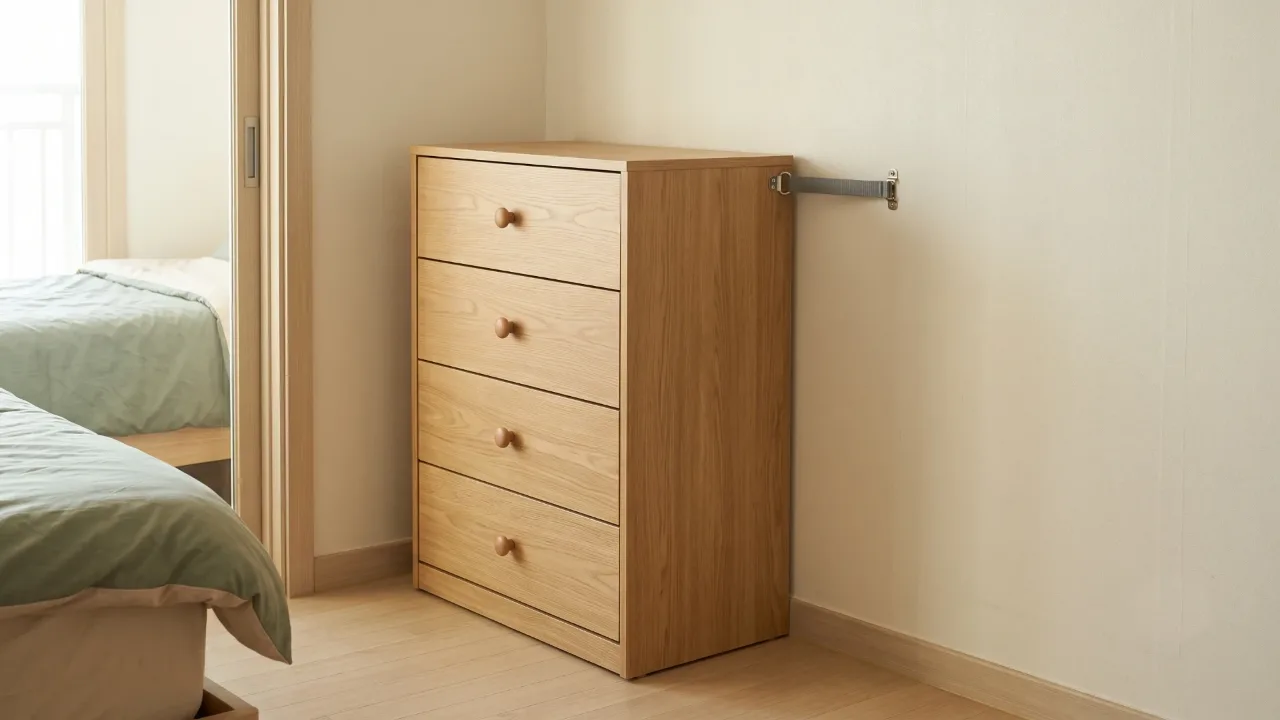
For a chest of drawers, put heavy items in the lower drawers and don't leave several drawers open at once. These are the rules the Korea Consumer Agency issued after analyzing furniture tip-over accidents in 2017.
The figures in this article come from the consumer safety alert announced on November 6, 2017. They tally cases received from 2014 through June 2017, so don't read them as current statistics. Safety standards may also have changed since then, so check the current standards once more when you choose a product.
How often does furniture tip over, and which furniture?
At the time of the 2017 announcement, the Korea Consumer Agency's Consumer Injury Surveillance System had received 129 furniture tip-over accidents over three and a half years. There were more than 30 every year, and no officially reported deaths in Korea, they said. The most common furniture was the chest of drawers.
| Furniture | Cases received | Share (of 129 cases) |
|---|---|---|
| Chest of drawers | 59 | 45.7% |
| Bookshelf | 35 | 27.1% |
| Wardrobe | 19 | 14.7% |
| Shoe cabinet | 9 | 7.0% |
Of the 117 cases where age was known, 65 involved children 14 or under (55.6%), and 51 involved children 6 or under (43.6%). One example the agency gave was a four-year-old whose foot was crushed when a chest of drawers fell as the child reached for snacks on top of it. A joint alert article from the Korean Agency for Technology and Standards and the Korea Consumer Agency, published in the Policy Briefing the same day, explained that chest-of-drawers accidents are common because children grab and hang from the drawers or step on them to climb.
Citing an OECD report, the article says that in the United States at the time, more than 33,000 people were injured every year by furniture or TVs tipping over, and a child went to the emergency room about every 30 minutes.
What should you look at when buying?
For a chest of drawers, first check whether it comes with a wall-fixing device. When buying a chest of drawers, the agency advised checking whether a wall-fixing device is provided, whether it stays stable with all drawers open or when a little force is applied, and whether it carries a KC mark and handling precautions.
The 2017 notice also includes a revised safety standard. From January 22, 2018, chests of drawers 762 mm (about 76 cm) or taller must come with a wall-fixing device. Children's and household chests of drawers must not tip over in a test with a 23 kg load, which assumes a child hanging from it, and must have a wall-fixing device attached or come with parts that allow one to be attached. For office filing cabinets, the notice says they must not tip over under a load of 100 N (10 kg).
This standard was set for chests of drawers and office cabinets. It doesn't mean the same test applies to bookshelves or gap storage units.
Where and how should you place it?
Avoid carpet or an unstable floor, and fix furniture that could tip over to the wall. The agency presents these two as the basics of the installation stage.
If fixing it to the wall is difficult, you can secure the top and bottom of the furniture or block the gap between the ceiling and the furniture. If installation feels daunting, it says to ask the seller or a nearby hardware store.
What should you watch out for in use?
Put heavy items in the lower part of a chest of drawers, and don't open several drawers at the same time. The agency also named these two first for the usage stage.
The agency advises not putting things on top of furniture that catch a child's eye, like toys, remote controls, and snacks, or heavy items. It also advises teaching children not to hang from drawers or step on them to climb, and to keep drawers locked whenever possible.
What should you check at each stage?
| Stage | What to check |
|---|---|
| Buying (chest of drawers) | Whether a wall-fixing device is provided, stability with all drawers open or with force applied, KC mark and handling precautions |
| Installation | Whether the floor is carpet or unstable, whether it is fixed to the wall, and if that's hard, securing the top and bottom or filling the gap to the ceiling |
| Use | Heavy items low, don't open several drawers at once, no toys, remote controls, snacks, or heavy items on top, lock drawers |
The sources were checked on October 7, 2026. Other articles worth keeping in mind are the power strip rated capacity article and the winter indoor humidity article.
Product information
Candidates compared
-
Agard Furniture Anchor Safety Device
-
Agard Hidden Button Drawer Lock
Check price and stock at the link. Product information is as of the date checked.
Frequently Asked Questions
What if the furniture can't be fixed to the wall?
The Korea Consumer Agency advises securing the top and bottom of the furniture or filling the gap between it and the ceiling. The same material also says to ask the seller or a nearby hardware store if installing the fixing device is difficult.
Do I not need to secure it if I have no children at home?
The material alone doesn't let us call that safe. In the 2017 alert, of the 117 cases where age was known, 65 were children 14 or under, and the remaining 52 were accidents involving people 15 or older. That figure of 52 is calculated as the difference between the two numbers, and the material doesn't give the cause.
Do bookshelves and wardrobes tip over too, not just chests of drawers?
Yes. The same count recorded 35 cases for bookshelves, 19 for wardrobes, and 9 for shoe cabinets. The Korea Consumer Agency pointed out that accidents often happen with storage furniture other than chests of drawers too.
Sources & Verification Date
- [Consumer Safety Alert] Beware of child safety accidents caused by 'furniture tip-overs' (Korea Consumer Agency, 2017-11-06) · Verified
- "Have you secured your home furniture firmly to the wall?" (Korea Policy Briefing and Korean Agency for Technology and Standards, 2017-11-06) · Verified
All materials have been verified from official announcements and may have changed since verification.